Thursday, December 17, 2009

AR: Exile on Main Street


The Rolling Stones - Exile on Main Street (1972)

In the continued interest of reviewing all the Phish-covered Halloween albums, here's the 2009 entry, The Rolling Stones dirty basement blues 1972 classic Exile on Main Street. Mick and Les Boys triumphantly managed to break exactly no new ground here, but somehow threw together a soulful batch of Brit-rock Americana that captures something way bigger than the sum of its tracks. It's gritty, dark and lived-in, and one of (if not the) best examples of the intimacy of a recording popping right through the music. Whether it was the drug-addled craziness that bore the album or who-knows-what, Exile saw a bunch of style-chasing bad boys - this is the same group that aped Sgt. Pepper's with Their Satanic Majesties Request - put down something undeniably real. It's a classic and proof positive that the Stones weren't always sucking in the Seventies.

Exile begins in typical RS fashion, with a classic bombastic Keith Richards riff followed by a rollicking, piano-backed verse of Jagger's barely pronounced drawl. "Rocks Off" has ample energy even before the horns kick in after the second verse, and the trumpet screams add to the flashing lights rock concert-style feel. Full band assault here - by the final choruses, things are in absolute full swing. Killer opener - even has a wacky psychedelic bridge that manages to disrupt but not feel out of place. The energy does not dip for track two, as "Rip this Joint" is (appropriately enough) a short roadhouse blues number featuring more full-speed ahead piano-trilling and a pair of crowd--slaying sax solos. Jagger spits his vocals out the side of his mouth - the music mercifully, for the sake of your record player, fades out before things start spinning off axes. Two more powerful and driving, yet murky and mysterious, opening tracks are hard to come by.

"Shake Your Hips" is an old-style blues riffer which basically sounds like the opening to some ZZ Top song on repeat. It's not 12 bar at all - just the same pattern over and over, with Jagger's eerie vocals and the brass section wildly shifting over the course of three minutes to keep things intriguing. The table is set nice and spooky-like - I'll try to avoid reiterating this throughout this review, but the image of half-drunk dudes rocking out while strewn about couches in some warehouse at 4 in the morning is pervasive. This mood sets the stage excellently for "Casino Boogie," another slow to mid tempo blues shuffle that starts off sparse and crescendoes to a brief jam out with some nifty full band, horns and all, interplay. You can easily see members finishing their individual runs, setting down their instruments and reaching for green-bottled brews.

As great as all of the songs, the closing track of side one of the original double LP, "Tumbling Dice [Gambling?]" is a step above and the obvious first single off the album. "There's fever in the funkouse now," indeed. It's a general tale of rock-starrin' and womanizing (gambling? :)), and the backup singers, another signature Richards riff, and the slowed down groove / drop-out choruses are flat out glorious. It's simultaneous raunch and summertime breezy groove - impressive stuff.

"Sweet Virginia" follows with some acoustic and harmonica stompin' country honk. More visions of basement sing-alongs as everyone in the studio seems to chant along with Jagger over the choruses. There's even a saxophone wail throughout, too - despite lines that you "got wipe that shit right off your shoes," this is a fun times, endearing tune - I, too, thank you for your wine, California. "Torn and Frayed" maintains the laid-back vibe with a banjo / piano / slide guitar combo - the Stones pulled off a lot more of an alt-country vibe than people often remember. That tendency is continued in the protest country blues number, "Sweet Black Angel," a lovely stripped down number challenging the murder charges brought against Angela Davis.

After that relative slow down and trek into political sincerity, the groups brings down the house with the side two, LP one closer, "Loving Cup." Full disclosure - I definitely heard the Phish versions of this first, and those particular cover versions led me to purchase Exile in the first place. As grandiose as those anthemic cover encores are, the original horn-backed and Jagger-sneer-led version is a flat-out lymbic accomplishment. Hard to say why this song, among all the piano and guitar led rockers on the disc, is so great - it really sits in the same genre as the bulk of the album - but that je ne sais quoi makes me reach for the non-existent lighter in my back pocket every time. It also accentuates how well organized Exile is - the sides feature big openers and closers throughout, so it's one of the more actualized double albums in that there are actually seemingly two albums within.

Case in point - side three opens with another riff-number (sorry for the lack of a better description, but there is something very particular about these mid neck Richards riffs that give The Rolling Stones that signature vibe) in "Happy." High energy, very similar in sound to "Rocks Off," replete with "Pround Mary" allusions, and a good move to kick off the latter half. "Happy" was the album's second single, too. It's followed by the straight ahead, non-standout "Turd on the Run," a quick, spastic number with nearly indecipherable lyrics. Nervous energy is going for it, so it still sinks in despite being a relative low point.

Things settle back in with a nasty slide riff blues romp in "Ventilator Blues," perhaps the edgiest song on the disc with snarling "When your spine is cracking" spat lyrics. A real thick, plodding groove gets set for this one, and even in the short 3:24 they manage to get quite a jam going. It fades nicely into the uberspooky "I Just Want to See His Face," a sort of meditative trance number with the ever-quotable "Let this music ... relax your mind" and "Don't wanna walk and talk about Jesus, just want to see His face." The backup singers and lyrical content give this a little bit of the gospel feel that has bubbling beneath throughout the album, a vibe that becomes more overt for the remainder of the album, starting in the next track, "Let it Loose." It's a bit melodramatic, a big anthem song in the tradition of "Wild Horses" or "Can't Always Get What You Want." This reflective tune closes side three.

Almost like clockwork, side four opens with another Richards' riff number in "All Down the Line"- pretty typical Stones fare again, with a catchy melody and a little bit of that edge. The horns really step it up here to make the tune stand out more than it otherwise would. "Stop Breaking Down" has the Stones covering something that sure sounds like Robert Johnson-era blues territory* - they rock its face off in a demonstration of what one can *actually* do with the 12 bar blues format. :)

* Ed. - I'm an idiot. That would be because it is a Robert Johnson song. :)

The gospel inflected "Shine a Light" is exactly the sort of dawn-breaking song one needs at the end of a long rock/blues/country/etc. excursion. It's a sort of confessional from Jagger, complete with organs, piano pounding, and a no doubt gospel choir. It keeps things on the right side of overdone - there's always a danger of self-parody with a big choir-backed number like this, but so much of the album has been steeped in down home, late night lick-laying that it comes off as sincere. Amazingly enough, they don't end with this number - it really sounds like the sort of benediction perfect for such a big album, but the Stones come back with an encore song of sorts in "Soul Survivor." Good call? I'm not sure, particularly since it's a choice to go from a positive, comforting message to the repeated taunt that "you're gonna be the death of me." It's also one of the two or three tracks on here that I don't just love, so I'm probably the wrong person to consult. Regardless, the Stones stay true to form and end their rough-around-the-edges epic with a sneer and in doing so cap off one of the classic authentic blues-rock works in popular music.

As you probably noticed, there's nothing weak on this album and really only one or two songs that don't make the good-to-great-to-transcendent categories. I guess Jagger's vocals could have been better articulated - his slurred drawl is all over the place throughout, though it's pretty perfect for this style - and some of the tunes are better mixed than others. But really, this is a boulder-sized gem of a double album, one that will definitely make the island suitcase. I think a lot of people who may have been into the Stones in the '60s but lost track of them at the start of the '70s are seriously missing out here - while this disc lacks the chart-topping singles of albums past, it's easily my favorite in the Stones catalog, and should be a required addition to all sensible collections. Exile lives up to the hype and maybe forces us to embrace the embarrassing notion that the Brits do Americana right - the master becomes the student becomes the master again. A hearty hat tip to that, and if this disc was indeed the love-child of many a heroin-fueled songwriting session, then I'm all in favor of legalization. For Jagger/Richards.

Status: Desert Island Recommended
Nyet's Faves: "Loving Cup" and "Tumbling Dice [Gambling?]"

p.s. Just a brief note that Phish TORE UP their live cover of this with the backing of Sharon Jones and the Dap Kings. Tons of highlights, but "Loving Cup" was far away the best version I've heard, and the "Ventilator Blues > Just Want to See His Face" segment was outstanding. Everything was fairly extended from the album version - the RS comes in at 1:07, and the Phish set tipped those same scales at 1:42 (though admittedly with some crowd noise and band intros and such). One of the best things - you can understand what Trey says! Yeah! Anyhoo, it was a fantastic choice / execution for Halloween, and some of the songs are still popping up in fall tour setlists. I heartily approve.

Wednesday, December 16, 2009

AR Redux: Live Up!


Giant Panda Guerrilla Dub Squad - Live Up! (2009)

This album, or at least a demo version of it, is already reviewed here, so this may be a little superfluous. But it'll get down the official take on the official release, and it'll give this review its own page (the original was a double review with Chinese Democracy). Better than all of that, the number of Album Review tags will now match the number of "Reviewed Albums" in that iTunes Playlist, which let me tell you what has caused all kinds of strife to date. Eesh.

Actually, all of that is bosh, as there have been some pretty substantial changes to the track selection. Here's a playlist comparison:

Live Up! Demo
Live Up! Release
Seasons Change
********Black Toke
Paranoia********International Mother
Work Very Hard
********Seasons Change
Easy Way Out
********Easy Way Out
International Mother
********Pollen Song
Pockets********Redrico
Walk Right Through
********Pockets
Black Toke
********In These Times
Live Up Dub
********Times Reprise
Melodica Dub
********Work Very Hard
Dylan's Times (Times Reprise)
********Dub One
The Body Song
********

So the dropped songs include "Paranoia," "Walk Right Through," "Live Up Dub," "Melodica Dub," and "The Body Song;" the new ones include "Pollen Song," "Redrico," "In These Times" and "Dub One."Some good moves here - I like the more sinister "Dub One" over "Live Up Dub," and I prefer "Redrico" as a second melodica-based dub. The other three dropped are some of GPGDS's pop-sensibility numbers, which is a shame, but probably best to balance out the album. And it's a good idea to include the dub-inspring "In These Times" since the reprise is on there, and "Pollen Song" is a killer riff, even if the lyrics count among Beck's least favorite. :)

I don't want to rehash the other review completely, so I'll just give the salient changes. One, this disc is mixed fantastically, and gives off the impression of simultaneously being in the dance hall with the guys but also having everything come through crystal clear. Many props to the mixer, as this is not an easy trick to pull off, and even more props t the musicians, who sound studio-precise even in the live setting. Hot damn. The disc now opens with the energetic "Black Toke" and Dylan's sick guitar slaps you upside the head before immediately letting you settle into the "International Mother" melodica slowdown groove. "Seasons Change" is about a minute extended with even more spaced out jamming; this version smokes and gives a great idea of the band's live range. "Easy Way Out" has some added reverb that gives the song an interesting feel; I think I might still like the demo version better, but the variety is nice. "Pollen Song" is now on here, and this is one of the most brain-swaying takes I've heard from the band; really sick dirty guitar work here. Great mid-disc trancer.

I really like the "Redrico" - "Pockets" combo - it's not the case, but the two are rhythmically similar enough the the former ends up sounding like an extended instrumental intro for the latter. Nice juxtaposition, and again, this "Pockets" is even richer than before. It also features a perfectly toned / placed trombone solo from a guest musician; great touch. "In These Times" has some sunshiney harmonies and chills things out before the racing jam-out that is "Times Reprise." A *seriously* worked out, 12 minute "Work Very Hard" follows, giving not just another full-band jam but also a chance to hear some individual soloing (most notably some bass riffage from Sir James himself). The album now closes with "Dub One" which is a nearly-bursting-at-the-seams quick spazz-out jam; cool close to the album.

In Live Up!, GPGDS has put together an excellent representation of their live show that puts all their talent in all its many forms on display. Bang up job, band - the only rec I would make is that "Paranoia," "Walk Right Through" and "The Body Song" be included as bonus tracks. Other than that, all I'm doing is salivating for the next show and Live Up! 2.0. Congrats on a great album; I can't wait to see what the new band structure will bring to my ears.

Status: Recommended
Nyet's Fave: "Seasons Change" (You'll recall that "Easy Way Out" is my fave from the demo, and that's still the case here, but as long as I have two separate albums now, I'll put two separate awesome tracks in my Nyet's Fave collection. Now you are caught up).

AR: XO


Elliott Smith - XO (1998)

This is the acoustic indie songsmith's major label debut (on Dreamworks SKG, leaving Kill Rock Stars) after being thrust into the limelight with the Oscar nominated "Miss Misery" off the Good Will Hunting soundtrack. Not a whole ton changed in the transition, and if anything he took brilliant advantage of the tech and cash available in the big time - XO has a brilliant sheen that invariably draws "Beatlesque" descriptions, but it does so without sacrificing his somber but melodic songcraft along the way. The album also retains multiple vocals tracks, all from Smith himself, and many acoustic tracks, also all played by Smith, giving the whole operation a rich, haunting feel in addition to the lush strings / piano and such added by the now affordable studio musicians.

XO is a decided exercise in juxtaposition, with catchy tunes and upbeat sing-alongs - there's a pair of WALTZES, for cripe's sake - peppered with dark lyrics of the general level of despair you might expect from someone who reportedly attempted suicide multiple times throughout its recording (Smith, terribly, would succeed a few years later, leaving us with yet another soul-crushing tale of depressive genius). The lines regarding death and dark thoughts are naturally colored by this context, as are the occasionally saccharine "fucks" and "shits" that crop up on occasion - that is a weird feature of this album, that sweet voice with all its angry cursing. The irony drips a little too loudly, methinks. The overall feel, still, manages to be that of crystal vocal beauty, and it's a sucker punch of sorts when it occurs to your consciousness that those honey-dripping harmonies aren't exactly expressing smiles.

The opener, "Sweet Adeline," is a descending guitar-riffed waterfall of a song that slowly crescendoes, nicely taking the quiet, late night initial notes to an exuberant chorus by its end. The song is timelessly well put together, the sort of song that evokes thoughts of its having been chiseled out of the air rather than putting together - all of which is to say that it sounds very natural. It's followed by the exquisite, baroque "Tomorrow Tomorrow," which sounds like an update / upgrade on the Don McLean catalog. Next comes the aforementioned "Waltz #2 (XO)," a well-executed toe-tapper, and one that sits just on the right side of the schmaltzy line. Yes, an unschmaltzy waltzy. Shut up.

"Baby Britain" makes sure the schmaltz line is a dot to you and borders on a showtune; again, whatever you might find irritating about it tends to be balanced by the lovely timbre involved. And this is probably the ultimate shortcoming of the disc - for all of Smith's dark poetry, there's something that's a little too poppy about a number of the tracks that makes this one best for occasional listens, lest the heart-on-sleeve emotivism get too irksome.

There are plenty of other highlights - "Independence Day" is sort of a slinky alt-folk mid-tempo gem, and "Bled White" gives Smith a driving rocker of a memorable tune. "Amity" manages to be one of the more annoying choruses in the history of indie rock (to later be challenged by this same album's "Question Mark"), but that annoyance is balanced by the could've-been-an-alt-rock-radio-hit "Bottle Up and Explode." The album closes on its most obvious Beatles homage, an a cappella ballad (that sounds strikingly like the sans-instrument "Because" take on Anthology III) called "I Didn't Understand." This one also contains lines about "such a fucking joke" that jar unnecessarily; I get the juxtaposition already, and the vulgar language against harmony detracts rather than enhancing the effect. Still, it's quite pretty, and a good bring down for the album.

I ended up complaining more in this review than I anticipated, so just to clarify - XO is a beautiful album despite all this, and indeed, ES is every bit the talent that we should be crushed to have lost. A lot of the earnest pop on here just gets to be too much for me, I think, and so as much as all the talent balances it, I find myself souring on this disc after too many listens. The album's also a bit uneven, and it's easy to forget the less stellar moments when the opening tricks pop to mind. So it's worth a listen, but be prepared to stomach some overpop along with the quiet, luscious goodness.

Status: Recommended (solid)
Nyet's Fave: "Tomorrow Tomorrow"

It's So Easy Being Green, Indeed

DSCF5921

It's So Easy (Being Green) completed an undefeated regular season last night, going 5-0 with a plus-minus of +37. Egads! We are now primed to choke away the playoffs (especially with Tom "Mary Kay Product" Studer being absent for the semis and finals on Thursday, ugh), but I thought I'd get this relaxed shot of Kermit in while I could. We clicked pretty well last night - 'twas a windless evening, and I got off about 6 or 7 big hucks for scores, got a nasty IO scoober off to Kyle for an easy goal and actually made a D or two - even managed to win a jump-disc against J-Trant, a complete novelty. Highlight of the night was an incut for Sullivan - he threw a forehand well off to my right / behind me, so in a distinct effort to not plant back and tear an ACL, I got my feet off the ground, laid out backwards and snagged the trailing edge of the disc. It can only be described as "Matrix-esque." Got some oohs and aahs from onlookers and everything. Also stood up and chucked it 50+ yards for the score after that, so yeah... Sportscenter here I come.

Anyways, yeah, this short season has been fun this far, and hopefully we'll pull it out tomorrow. Though it's going to be tough - without Studer, we'll have to bump up our defensive matchups, always a pain in the arse when other teams have two or three burners. We'll see how it goes.

Tuesday, December 15, 2009

In Light of Evolution, or PinkÉ™ at SacklÉ™

So big disclaimer - I have to be relatively careful here, unlike my normal shoot-from-the-hip express thyself with impunity style, because I'm guessing that if Christastrophe can track me down using google analytics, these high power science types can probably do the same and squash me like the academic piss-ant that I am. So take the following commentary as you will.

This past weekend I traveled* to the OC to attend the Sackler Colloquium sponsored by the National Academy of Sciences entitled "In the Light of Evolution IV: The Human Condition."** It's a rather prestigious conference with a number of big deal speakers and a bit of an odd format. There's only one lecture hall, all of the speakers talk in it in succession, and you spend a serious amount of time listening to said talks: eighteen 50 minute talks over two days, with some coffee breaks and lunches and dinners sprinkled inbetween. The topics are all over the map, though at least in principle centered around evolution and the human condition. Long days and a ton of interesting information, though there are some interesting dynamics going on that I'll try to capture here.

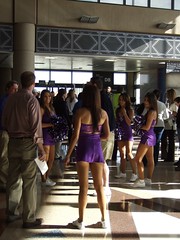
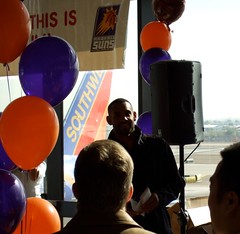
* - You will recall that I had a flight delayed by three plus hours and was inserted into a dream world of gorillas, Suns girls and Grant Hill. I wasn't lying:

DSCF5902 DSCF5900 DSCF5903 DSCF5905

See? I *told* you the cheer outfits were absurd. Though, as Beck will tell you, nowhere near as absurd as the one we witnessed on lovely 24th street in Phoenix lately. Sheesh. That one is definitely NOT making an appearance in the Ballad.

** - "Nothing in biology makes sense except in the light of evolution" is a rather famous and oft-referenced quote / series of essays by Theodosius Dobzhansky, a sort of grandfather of evolutionary biology and the "modern synthesis" aka neo-Darwinism (or whatever the least offensive term is these days). He's known as "Doby" to his close friends and/or the kind of people who casually drop such tidbits in their lectures. I, ftr, do not know him as "Doby." Having read a whole lot of biology over the last few years, though, I'm going to have to agree. :) I mean, seriously, your genome is something like 30% mobile elements, pointless little sequences that do nothing much more than wreck other genes. Something like 1.2 million of them have been copied and copied and copied over the millenia. And your genome is also largely composed of remnant pseudogenes, no longer functioning sequences with all components of genes that are rendered inactive by accumulated mutations / errors / etc. So, um, show me a car that has a ton of the same random part strewn about it occasionally causing other parts to break, show me a bunch of other parts that would have worked in older models but no longer do, explain to me why an engineer would do that, and then we can start talking about intelligent design. Sound good?


The most obvious thing is that it's a non-specialty conference - you've got paleontologists, anthropologists, evolutionary biologists, biochemists, primatologists, evolutionary psychologists, geneticists, and the list goes on and on, all as speakers, let alone the variety of people in the audience (see, um, biology-based ethicists aka Nyet Jones). So you've got power player speakers, all of whom come from decidedly different backgrounds, some disciplines which have beefs with one another - most notably evo bio and evo psych, but also social scientists and "hard" scientists generally. But you've also got decorated experts in all of the fields sprinkled throughout the audience. The overall effect? First, there was an extreme air of deference. I'd venture that 95% of the questions that were actually asked* were of the softball variety. No serious challenges to claims, concepts, underlying methodology, none of the stuff I hear on a daily basis at talks at school. This was cool, on the one hand, because the oneupsmanship that goes on elsewhere can get a little tired. But on the other, it seemed that a lot of ideas went down completely unchecked - I would have enjoyed some interdepartmental wrestling, though I can understand why they perhaps did not want to foster that. I also saw a whole lotta hat-tipping and cultish lust for all things science. I get that it's a science conference and I shouldn't really be surprised, but I could have a used a bit more articulation with humanistic notions of "The Human Condition" subtitle.

* - This was a problem - speakers were given 50 minutes, and while the conference as a whole was run exactly and admirably on time, most of the speakers ran over by a minute or so and permitted little to no time for questions. I don't know if this was by design (i.e. people didn't want to have to answer a lot of q's in that environment; that seems unlikely, though, as these were all dynamic speakers at ease in front of the crowd and see the above notes on deference) or if people were just taking the long talk format to riff as much as they wanted. It definitely did not foster a whole lot of give and take - I asked no questions, but I probably would have chimed in on two of the talks in particular had there been more opportunity. Anyways, weird format, not to mention a little long-winded at times, and I would have preferred maybe 35 minute talks with fifteen minutes for Q & A or extended jamming or something. As it was, you had to try to grab people in coffee breaks or at dinner, and especially with some of the big-time guys (e.g., Ayala), it's hard to break into a crowd of ten people to have a real conversation over a ten minute coffee break.

The second effect, though, was a bit more disappointing. For the most part, the talks stuck to pretty surface level, survey course style accounts of research. I think people knew they were delivering talks to a broad audience - which they were - but as a consequence, some of the stuff presented amounted to summaries of a disciplinary approach or a life's body of work, and if you were familiar with the speaker's work already, it came off as a whole lot of stuff you already knew. Which, if you've flown far, spent several days alone in a hotel room etc. to hear, can be a bit irksome. Not that this held back the conference - I heard a lot of really cool stuff and learned a lot from the people I didn't know - but the people I specifically went to hear largely failed to deliver something that I hadn't already gleaned from reading their publications. Ah, well.

So, aside from my usual negative Nelly intro - long talks, surface talks, too much nicety to really hear what's going with scientific takes on the human condition, too much sitting in a single room* - the conference was quite nice. I had to cab it to and from the hotel, but otherwise, all transportation was taken care of - buses to and from the hotel (which was the shwanky Newport Beach Marriott) to the very posh Beckman center. We were served two excellent breakfasts and dinners and a wine-drenched banquet dinner as well as lots of gourmet coffee and snacks throughout both days. No complaints at all about the amenities; they were quite ridiculously good.

* - Holy footnotes Batman - but it's worth noting that I had Vietnam-style flashbacks to med school this past weekend, what with the single lecture hall, the power points, the fifty minute lectures, the occasional nodding off at a too-monotone discussion ...

There was time to chat over meals with various people, though as noted, with all the people there who already knew one another, it was sometimes a little tough to grab a table with a person you might want to talk to. I definitely would like to go to the next conference with someone I know - I was all by my lonesome, and while I'm okay at striking up conversations with strangers, it's a lot easier to join conversations in progress. The best chats I had were with groups of other students / professors at meals who all knew one another - I tracked down some of the interesting philosophy people in attendance, and it helped a ton to have them already engaged in various conversations and just slide in with a comment rather than doing the usual game of I'm so-and-so and what do you study? So that was cool - I met some UC Irvine people doing various things with monkeys and morality, people I might be interested in thinking back and forth with over the coming years. But man, in the other conversations - there were a whole lot of highly specialized scientists there, and let's just say that there isn't a whole hell of a lot for a guppy biogeographer and an ethicist to talk about. At one point I listened to a twenty-plus minute speech on a student's beetle dispersion statistical analysis, and while it was highly impassioned and clearly the awesomest thing in the world to that guy, I felt very out of place. Like a guppy out of appropriate biogeographical evolutionary niche, if you will. Still, I said "ethics" and generally got enthusiastic responses - seems a conference on the human condition grabbed people who were at least seemingly interested in how biology and evolution can speak to ethics. On occasion, of course, I said ethicist and either got sort of "Oh, a philosopher" type reactions or people who felt ready to comment on the entirety of my discipline based on a book they had read one time. I always find that wacky - like I would challenge a genomics expert on his area of study because I took a genetics course once? Seriously, somebody was trying to tell me, "well, morality is all based on fulfilling hardwired desires, so that's really already figured out." Oh, okay. Thanks. I'll go tell the postmodernists. Vague insults aside (one prof tried to ask me what my experimental design was going to be, and I'm still not sure if he badly understood me explanation of my interests or if he was being a colossal empiricist dick), people were generally welcoming and friendly. A good time, despite my inherent distaste for those type of "let's network" environs.

The last thing to add before jotting down a bullet summary of the talks is to note that I do not like traveling by myself. Most people probably don't, but there's something quite lonely about the empty dark hotel room, no matter how Marriottish it is. There was a mall nearby, so I walked around there quite a bit (in the pouring rain - 50 degrees and wet all weekend, thanks a lot southern cali!) during the little down time that I had (Thursday night and after 4 on Saturday), but otherwise it was a lot of hotel room hanging out, reading and watching TV / DVDs. (I did catch the ESPN 30 for 30 on "The U," which was quite awesome. I now realize why I spike on the Ultimate field - I'm a 'Cane at heart!). Anyhoo, I was very glad to be back with the Beck and the dogs come Sunday. We (minus the S/W) grabbed some dinner and football with D/C and had a great time - good to be home.

Okay, point by point, lecture by lecture - I can't believe you're still reading!
  • E.O. Wilson - who is as rock star evo biologist as they get - gave a talk called The Four Great Books of Darwin. I've heard so much of this stuff in my HPS course lately that I wasn't thrilled at the topic, but he did an admirable job. He did give a little dig - told this joke about how mathematicians achieve their peak in their teens, physicists in the 20s, chemists in their 30s, biologists in their 40s-50s and philosophers never. Well, Mr. Wilson, I believe after all these years, you're still all wet. So there. Phbbbt. :)
  • All of you high power scientist career breakers, that previous comment was a light-hearted joke. Please don't end me.
  • Bernard Wood, paleontologist, gave a great talk on the evolution of hominids. The primary point was that it is very difficult to take a fossil specimen and place it in the evolutionary tree appropriately - it's hard to be sure if any given species is in direct human lineage or is an offshoot of one of the branches.
  • Kristen Hawkes, anthropologist, talked about human longevity and the evolution of post-menopausal life. It's 1, not a recent development, and 2, something we don't share at all with the apes.
  • Juan Luis Arsuaga spoke on human ape-relatedness and effective uniformity in the fossil record
  • Douglas Wallace gave an interesting talk about energy as the fundamental concept of human life, talking extensively on the evolution of mitochondria and how, among other things. lack of mitochondrial ox-phos uncoupling for thermal purposes accounts partially for why Kenyans are so good at marathons. Lively speaker.
  • Anna DiRienzo spoke on genetic variation and its service to evolution in the presence of local environmental factors.
  • Sarah Tishkoff gave a very cool talk on tracking human genomic lineage in Africa.
  • Mark Baxter spoke on the above-mentioned mobile elements and their historical dynamics in the human genome.
  • Carlos Bustamante gave a statistically technical talk on personalized medicine and the human genome - lots of cool stuff on being able to track human migration over the millenia via genomes.
  • Morris Goodman, another rock star, gave a general talk on evolutionary evidence in human lineage
  • John Avise gave the banquet lecture entitled Non-intelligent Design: Inside the Human Genome. 'Twas a general refutation of the notion of the design (also referenced above) in the human genome given all the mayhem and utter failure that is evident within it. His argument was well-supported, but I wonder about his audience - who's going to be swayed by this who isn't already swayed by, say, back pain? He also closed with a rather wacky notion (shared by Ayala, I gather) that evolutionary theory is actually a gift to religion, as now reli doesn't have to account for many forms of human misery as it falls under the domain of science. "They" can focus on meaning and spirituality and morality/ethics and all that stuff. I have alluded before to the chapter 7 phenomenon - where the science writer delivers a perfectly cogent argument and that tacks on some bizarre, ungrounded humanities oriented commentary at the end. This was it par excellence - it implies that you could completely undermine the metaphysics of a religion and leave it largely intact for those "types of things science can't do." Which is, in a word, dubious - you're basically asking for a tacit admission of a God of the gaps who can only cover non-empirical ground. I think that's a bit dismissive of the role of religious narratives in the belief structure - anyways, not to go all hypercritical on this, but I just thought that was a weird tag on to an otherwise finely put point, that the genome is riddled with evolutionary evidence that makes no sense if viewed from an intelligent design perspective.
  • Saturday morning opened with a fantastic talk from Nina Jablonski called The Skin That Makes Us Human, an account of melanin evolution in different climates. This was probably up there for the best talks of the weekend (for me) - just really drove home the point that skin tone is a magnificently malleable trait, and the interplay between UV protection and Vitamin D synthesis dictates not just skin color but hair color, distribution, etc. The *malleable* point was huge - there have been numerous independent evolutionary events that have changed population's skin colors, which indicates that relative to a lot of traits, skin color, aka one of the primary determinants of race, is actually one of the more fleeting characteristics of peoples when considered on evolutionary time scales. If one were to start with an ethical premise that treatment of others not be arbitrary - and then note based on scientific evidence that one of the main things we use to differentiate peoples is that highly "temporary" trait - I think one has something resembling an logico-empirical stance that racism is idiotic. I'll need to come up with a more eloquent way of phrasing that at some point, but it was quite a lovely point in a conference that occasionally wandered off the "Human Condition" topic.
  • Ajit Varki gave a very detailed, fascinating talk on unique patterns of sialic acid biology (i.e. cell surface sugars / potential antigens) and the evo histories of certain ones that appear in humans but not other species (and their impact on disease). Science-detail heavy, but quite sharp stuff.
  • Peter Richerson gave a largely apologetic talk on how culture evolution studies are some 75 years behind bio ones. He alleged that variable climate seemed to spark human cultural development. Dubious? Maybe. This was essentially a claim that cultures follow Darwinian rules, which always treads a bit in meme territory for me - is it the cultures undergoing evolution, or the people who practice them? Unclear.
  • Francisco Ayala, another fretboard burner rockstar biologist, gave the weirdest talk of the weekend (again, for me). It was called The Difference of Being Human, but focused entirely on the biology of ethics. The claim was that ethics can be split into two concepts - the capacity / proclivity to judge right and wrong, and the actual instantiation of what determines to be right and wrong. Ayala claimed the former is biologically / evolutionarily determined (the capacity for abstract thought, anticipation of action outcomes, the ability to contemplate and choose possible alternatives) and the latter, the particularities of what is right and wrong, is largely culturally determined. It's a distinction between capacity and code. (Ayala further claimed that he could make a similarly structured argument for many human cultural practices - aesthetics, religion, etc.). To be honest, the first part was unremarkable - it was supported by top notch biology, to be sure, but it was just a typical "humans are unique animals" type argument that alleged that this was key to our moral foundations. He also alleged that our bipedal gait permits tool development which drives brain development which drives more tool development, etc., which results in our big, abstract thought conceiving brains. The second part was simply bizarre - after a brief run through the history of ethics, he alleged that our ethical beliefs are largely cultural, and that the successful ones are determined by natural selection. This was essentially an argument that moral peoples will be more evolutionarily successful than non-moral ones (or maybe cooperative groups will outdo non cooperative ones) without a specification of what being moral means. The obvious question here is how this articulates with an endorsement of moral relativism, since it seems to boil down to a rule that survival will trump other concerns. I wanted to ask this, but didn't get a chance as some other grad student made an ill-advised challenge to Ayala's criteria for moral capacity (the student made a fair point, but got shot down in front of everyone for being unable to properly articulate it). Anyways, I'd be interested in reading Ayala's books - he is a former Dominican priest, so one imagines he has some moral philosophy / theological chops, even if it didn't come across in this lecture too much. In short, I found this very superficial and reeking of chapter 7-ness, though I am also confident that Ayala has probably outlined the idea better in other venues.
  • Leda Cosmides gave an utterly boring talk called Whence Intelligence that didn't seem to have much to do with intelligence but rather a "mental module" of cheater detection. I should qualify that - it was boring because it was a *survey* on cheater detection, the literature of which I am already profoundly familiar and find problematic for a whole truckload of reasons. So perhaps for people unfamiliar with her work it was interesting; I can't speak to that, because all I heard were arguments and evidence that have been in play for some fifteen years. She was one of the people I was most excited to see because I am fairly familiar with the back and forth that she and anti-evo psychologists have undergone, so I wanted to hear something of a response to the challenges or a take on how this affects our conception of the human condition. I got neither, so her talk was something of a letdown.
  • Terrence Deacon gave an overly long talk called Whence Language, and I will pay you handsomely if you can explain how this said much about human language. It was a lot of stuff on birdsong, to be sure, but again missed the larger point of things for me.
  • And finally, Steve Pinker closed with a talk on the Evolution of the Mind. Pinker was the show closer, the guy I had come to see, and he gave a somewhat demure performance and more or less rehashed some of the things from his popular works on language and the blank slate of the mind. He was stunningly non-assertive - of all the people there, he seemed the most keenly aware of the differing theories from his own present in the room that afternoon. I doubt he was nervous, but he was a lot less lively than in, say, his Colbert Report appearances. The talk included thoughts on the intelligence measure G and our lack of ability to pinpoint its genetic underpinnings and our pervasive use of metaphor in language which he points at as evidence of a generalized preference for abstraction. He specifically made a point that though a large percentage of our mental association is sensory driven a la Proust, there is a certain percentage that comes about via this metaphoric, structural brain associations. He also argued that while skin colorations and other specific biological traits are important for explaining our multiple niche compatibilities, our mind is largely the thing that permits our varied dominance of earth's nooks and crannies. He made a slew of other Pinker-typical, interesting points, too. It was odd that he read his lecture from notes and again, gave a very soft-spoken presentation of ideas. He was also the only person who got challenged (really) in the Q&A afterwards - people griped with the specifics of his notions of intelligence inheritance. All in all good stuff, but again, the survey nature of the talk was disappointing - I'm glad I got the chance to hear such a pop scientist celebrity talk, but I was genuinely surprised by the low key feel of it.
Phew. So that's it. Definitely a good experience, but also definitely one that good use some tweaking. I was probably most fascinated by the meta-anthropology at play - scientists talking to scientists, wheeling and dealing, trying not to stick foot in mouth and some wielding their cachet like 50 Cent at da club. Fascinating. Hopefully next time I will be a bit more of a participant observer and not just an observer - I feel like a did a good job socializing and as mentioned met a few people who might be interesting to work with, but I can definitely work on shmoozing profs and figuring out a way to convince them that an ethicist / non-strict scientist is worth their time. Things to work on. Until next time, that's the lyrical tale of the past weekend with Nyet and the OC. Looking forward to more interesting conferences to come.

Phxated on...

I'll avoid the faux-Freudian jokes here, but last night I headed to Phxation practice to help Joanne out with some dumping drills. Dumping is when you rest the stall count with a short (generally) backwards pass; sort of the equivalent of an outlet option or a drop pass in soccer. Nothing terribly exciting to post except to note that we had a good practice - I think Phxation, now that they have achieved a certain level of skill, can really benefit from having some more well delineated team strategy in practice. Good times, even if there were only eight people in attendance - it worked well for a lot of small group teaching, so that was okay. NEhoo, here are some notes on dumping strategy, if you ever find yourself in need:

*********************************************************
I. Positioning

1. If in the middle of the field, 45 degrees on the open side, back 5-8 yards
2. If on the sideline with a force middle mark, 45 degrees, 8-10 yards
3. If on the sideline and trapped, parallel, 5-8 yards (or farther if you and thrower are comfortable)

II. Activating

1. Stall 5 if in the middle of the field
2. ASAP if trapped or on the sideline generally

3. Thrower activates by turning and making eye contact / facing the dump
4. Dump needs to be active and get thrower's attention on stall 5, too
5. Upfield cutters need to recognize when dump is active and not cut in toward the disc on the open side (don't take away options!)

III. Read the Defense

1. Not playing D? Just throw it.
2. throw guarding (i.e. defender is only looking at the thrower?) - fake once, dump opposite way
3. Face-guarding (i.e. defender is only looking at dump?) - dump fakes one cut, goes other way, thrower dumps to space
4. Triangle-guarding? - dump fakes and goes other way - important to read the defense and take the direction they are giving you

IV. The Cut

1. No squirreling!!!!
2. One fake (at most) and GO the other direction
3. Cutting tricks - get your defender to back pedal, step out of their vision, block them off with your body, etc. (we didn't talk about this much last night)
4. Getting open is hard work, so work hard - when push comes to shove, the dump needs to get open on their own. I.e., this system helps, but it does not make
5. Particularly when trapped, make sure you are cutting toward the disc - there's a tendency to just head up field in a sort of perpendicular cut, and this actually is increasing the distance between the thrower and the dump, making the throw more and more difficult as time passes. Lots of good dumps are two foot throws, so be sure you're staying close.

V. The Throw

1. Backhands if possible (thoguh there are times when forehand will be dictated, esp. on the sideline)
2. Get low, step away from the mark, and use a flip back hand (not a full wind-up)
3. Lead the receiver - throw to space, and throw early - don't wait until you see separation, but trust that it will develop
4. Attack with the dump - not just a rest, but you can put the dump in a huck position or on the break side with a good dump.

VI. Continuation

1. Open side or fish cut - you can put the dump in a huck position. Cutter on the opposite side of the field should see this and time deep cut accordingly
2. Dump on the break side can lead to big, easy swings - again, cutters should recognize!
3. Give and go, weave - there are other handler moves you can work on off of these throws, too.

VII. Team Setting

1. Important for cutters to see what's going on - again, don't cut into the dump area, and be ready to cut or clear depending on what happens with the dump.
2. Cutters in ho-stack should also be aware - if mark starts cheating and trying to D the dump, there are easy break throws available upfield.
3. The other handler (the non-thrower, non-dump) will generally do the opposite of what the dump did, either to provide a second option (in case the thrower can't get the dump off) or to clear the way for the swing.
4. One of the break side cutters in the ho-stack (probably not the 4th cutter away from the disc but the 3rd) needs to read the dump, too - if the dump comes back to the middle of the field, cut in hard for the swing as you should already have an advantage on the break side. If the dump goes up the line (fish cut or otherwise), the best deep cut comes from the break side to make the throw as easy as possible.

*********************************************************

Happy Holidays from Sparks and Wrigs

sparklejoyhnson wrigleyjohnson

And as long as you're enjoying this endearing, longtime torture of children/animals who have no idea who the hey that bearded guy is, you might as well check out Sketchy Santas.

In other news, to celebrate this 5th night of miracles, Fred got her ovaries excised today. Rumor has it she tried to walk off the operating table, entrails hanging out and still under anesthesia. That crazy cat, I tell you what...

P.S. Please note that these Santa pictures were taken while I was out of town. I would *never* permit such activities. Besides, S & W only celebrate Chrismukkah and Festivus, not this Santa Claus business.